
- Vishnu Inugala
- April 2026
- Digital Marketing
Introduction
Startups are often seen as symbols of innovation, ambition, and disruption. Yet behind every success story are countless failures that never make headlines.
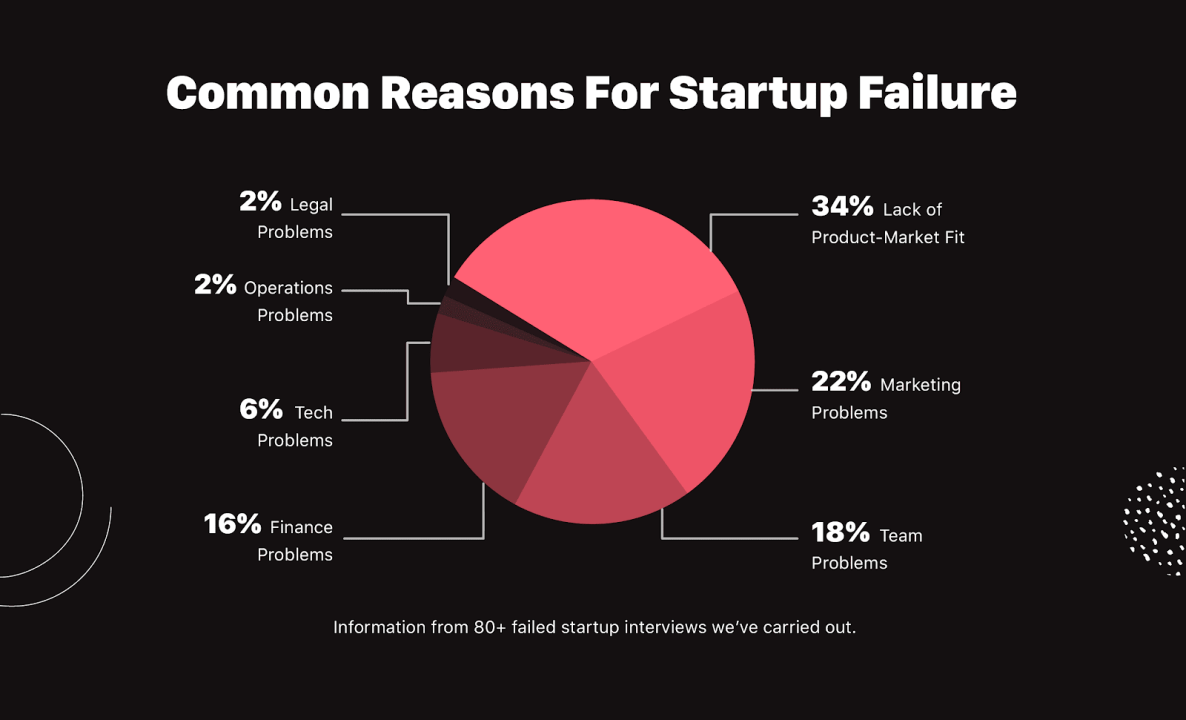
Studies across the industry consistently show that a large percentage of startups fail within the first few years. The reason is rarely a single mistake — it’s usually a combination of flawed assumptions, weak execution, and strategic misalignment.
This blog breaks down why startups fail, not at a surface level, but from a founder and leadership perspective.
1. Building Without a Real Problem
The most common reason startups fail is simple:
1. They solve problems that don’t actually exist.
Many founders fall in love with an idea instead of validating the need.
What happens:
- Product looks impressive
- Technology is strong
- But users don’t care
Strategic insight:
Success is not about building something innovative — it’s about building something necessary.
2. Lack of Product-Market Fit
Even good ideas fail if they don’t match market demand.
Product-Market Fit (PMF) means:
1. Users actively want your product
2. They find real value
3. They keep coming back
Without PMF:
- Growth stalls
- Retention drops
- Revenue doesn’t scale
3. Poor Financial Management
Many startups underestimate:
- Burn rate
- Operational costs
- Time to profitability
Result:
- Run out of cash
- Depend heavily on funding
- Lose control of the business
Leadership mistake:
Focusing on growth without sustainable economics.
4. Weak Founding Team & Leadership Gaps
A startup’s strength depends on its founders.
Common issues:
- Lack of domain knowledge
- Poor decision-making
- Internal conflicts
Execution matters more than ideas.
Strong teams:
1. Adapt quickly
2. Handle uncertainty
3. Make tough decisions
5. Overengineering & Misplaced Priorities
Many startups focus on:
- Perfect architecture
- Advanced features
- Complex systems
Instead of:
Delivering value quickly
Reality:
Users don’t care about your tech stack — they care about results.
6. Ignoring Customer Feedback
Startups often assume they know what users want.
Mistakes:
- Not collecting feedback
- Ignoring user behavior
- Building in isolation
This leads to product misalignment.
7. Scaling Too Early
Premature scaling is a silent killer.
Examples:
- Hiring too fast
- Expanding too soon
- Spending heavily on marketing
Without strong foundations, scaling:
Amplifies problems instead of success
8. Misusing Technology & AI Hype
Today, many startups jump into AI using platforms like OpenAI API without a clear strategy.
Common mistakes:
- Adding AI for hype
- No real use case
- Poor implementation
Technology should support the business — not define it blindly.
9. Lack of Clear Business Model
A startup must answer:
How will we make money?
Without clarity:
- Revenue is unpredictable
- Investors lose confidence
- Growth becomes unsustainable
10. Market Timing Issues
Even great ideas fail if timing is wrong.
- Too early → Market not ready
- Too late → Competition dominates
Timing is often as critical as the idea itself.
Key Strategic Lessons
Successful startups focus on:
1. Real problems, not assumptions
2. Continuous learning and adaptation
3. Sustainable growth, not hype
4. Strong execution over perfect ideas
Founder Mindset Shift
From:
“Let’s build something cool”
To:
“Let’s solve something meaningful”
Conclusion
Startup failure is not random — it is predictable and preventable in many cases.
The difference between success and failure lies in:
- Clarity of problem
- Strength of execution
- Ability to adapt
In the end, startups don’t fail because of lack of ideas —
they fail because of lack of alignment between idea, execution, and market reality.
Final Thought
If you understand why startups fail,
you are already closer to building one that succeeds.