- Suneel Mekala
- May 2026
- Artificial Intelligence
Introduction
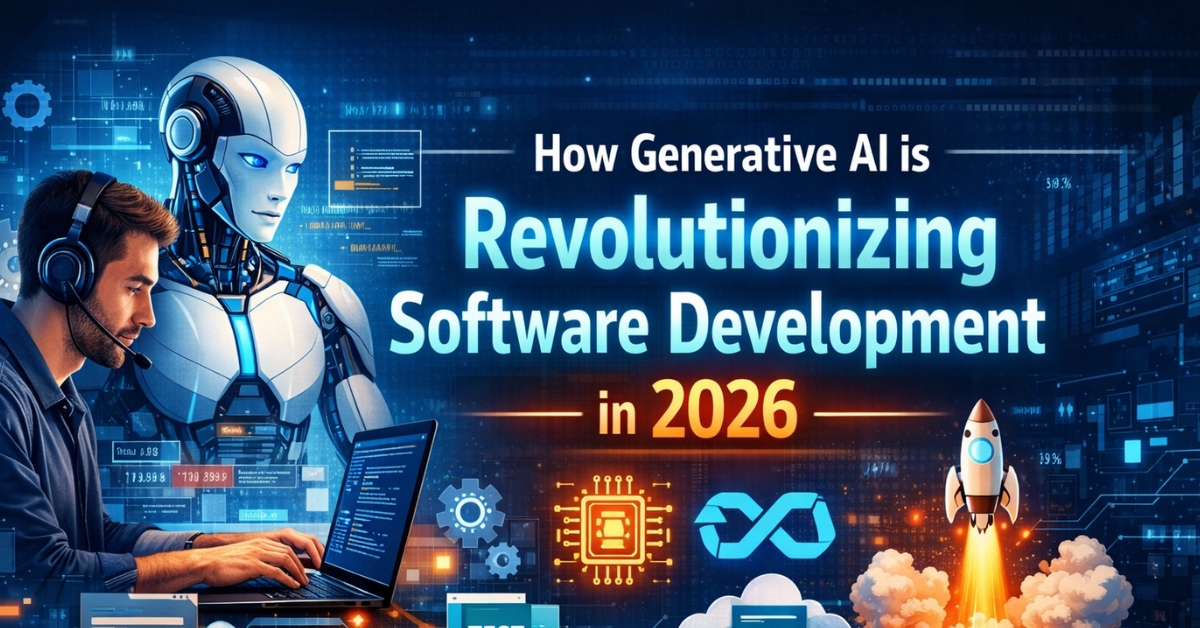
The software development landscape in 2026 looks dramatically different from just a few years ago. Generative AI has evolved from being a simple coding assistant into a powerful innovation partner that helps businesses design, build, test, deploy, and maintain custom software solutions faster and more efficiently than ever before.
From startups to enterprise organizations, companies are now integrating Generative AI into every stage of the software development lifecycle. This transformation is not only reducing development time and costs but also improving software quality, user experience, and business scalability.
In this blog, we’ll explore how Generative AI is revolutionizing custom software development in 2026 and why businesses are rapidly adopting AI-powered development practices.
What is Generative AI?
Generative AI refers to advanced artificial intelligence systems capable of generating content such as text, code, images, designs, and even software architectures. Technologies powered by large language models (LLMs) can understand human instructions and generate meaningful outputs with remarkable accuracy.
Popular AI-powered development tools now assist developers with:
- Code generation
- Bug fixing
- UI/UX design suggestions
- API creation
- Automated testing
- Documentation generation
- Database optimization
- Security analysis
In 2026, these tools have become an essential part of modern software engineering.
1. Faster Software Development Cycles
One of the biggest transformations brought by Generative AI is the significant reduction in development time.
Traditionally, software development involved extensive manual coding, repetitive tasks, debugging, and testing. Today, AI-powered coding assistants can generate production-ready code within seconds.
How AI Speeds Up Development
- Converts natural language prompts into code
- Generates reusable components automatically
- Creates backend APIs instantly
- Suggests optimized algorithms
- Automates repetitive development tasks
For example, developers can now describe a feature like:
“Create a secure login system with JWT authentication and role-based access control.”
The AI generates the required frontend, backend, and database logic automatically.
This allows developers to focus more on innovation and business logic instead of repetitive coding.
2. Improved Software Quality and Reduced Bugs
In 2026, Generative AI tools are highly advanced in detecting errors, vulnerabilities, and inefficient code patterns.
AI systems continuously analyze source code and provide:
- Real-time bug detection
- Security recommendations
- Performance optimization tips
- Code refactoring suggestions
- Dependency vulnerability analysis
Benefits for Businesses
- Fewer production issues
- More stable applications
- Faster debugging process
- Enhanced application security
- Better software performance
This results in reduced maintenance costs and improved customer satisfaction.
3. AI-Powered UI/UX Design
User experience plays a critical role in software success. Generative AI now helps designers and developers create highly engaging and responsive user interfaces.
Modern AI tools can:
- Generate UI mockups from text descriptions
- Create responsive layouts automatically
- Suggest color palettes and typography
- Improve accessibility standards
- Personalize user experiences dynamically
Businesses can rapidly prototype applications and validate designs much faster than traditional methods.
4. Smarter Customization and Personalization
Custom software development is all about building solutions tailored to specific business needs.
Generative AI enables hyper-personalization by analyzing user behavior, preferences, and workflows.
Examples of AI-Driven Personalization
- Personalized dashboards
- Smart recommendation engines
- Adaptive workflows
- AI chat assistants
- Dynamic content generation
This creates more intelligent applications that adapt to users in real time.
5. Automated Software Testing
Testing is one of the most time-consuming parts of software development. In 2026, AI has automated a large portion of testing activities.
Generative AI can now:
- Generate unit test cases automatically
- Create API testing scripts
- Perform regression testing
- Detect edge cases
- Simulate user interactions
Impact on Development Teams
- Faster release cycles
- Higher test coverage
- Reduced manual effort
- Improved software reliability
Teams can confidently deploy updates with minimal risk.
6. Enhanced Collaboration Between Teams
Generative AI acts as a bridge between technical and non-technical stakeholders.
Business teams can explain requirements in natural language, and AI tools convert them into technical specifications, workflows, and even initial code structures.
This improves communication between:
- Developers
- Designers
- Product managers
- Business analysts
- Clients
As a result, projects experience fewer misunderstandings and faster execution.
7. Cost Optimization for Businesses
Generative AI significantly reduces operational and development costs.
Cost Benefits Include
- Reduced manual coding hours
- Faster project delivery
- Lower QA/testing expenses
- Reduced maintenance overhead
- Smaller development teams handling larger projects
Startups especially benefit from AI-assisted development because they can launch products faster with limited resources.
8. Intelligent DevOps and Deployment
DevOps workflows in 2026 are heavily AI-driven.
Generative AI helps automate:
- CI/CD pipeline generation
- Infrastructure configuration
- Deployment monitoring
- Server optimization
- Error log analysis
AI systems can even predict deployment failures before they happen.
This improves system uptime and ensures smoother software releases.
9. Better Cybersecurity in Applications
Cybersecurity threats are becoming more advanced, but Generative AI is also strengthening software protection.
AI-powered security tools can:
- Detect suspicious code behavior
- Identify vulnerabilities early
- Recommend secure coding practices
- Monitor threats in real time
- Generate security patches automatically
Security is now integrated throughout the development lifecycle rather than being treated as a separate phase.
10. The Rise of AI-Augmented Developers
Contrary to popular belief, Generative AI is not replacing software developers. Instead, it is transforming developers into highly productive AI-augmented engineers.
Developers now spend less time writing repetitive code and more time on:
- Problem solving
- System architecture
- Innovation
- Business strategy
- User experience improvements
The role of developers is evolving from “code writers” to “solution architects.”
Challenges of Generative AI in Software Development
While Generative AI offers many benefits, businesses must also address several challenges:
Key Challenges
- Data privacy concerns
- AI-generated code quality validation
- Intellectual property issues
- Bias in AI models
- Overdependence on automation
Organizations need proper governance, security practices, and human oversight to maximize AI benefits responsibly.
Future of Generative AI in Software Development
The future of software engineering is deeply connected with AI innovation.
By the end of this decade, we can expect:
- Fully AI-assisted development environments
- Autonomous debugging systems
- AI-generated enterprise architectures
- Intelligent software agents
- Self-optimizing applications
Businesses that embrace AI-driven development early will gain a strong competitive advantage.
Conclusion
Generative AI is fundamentally reshaping custom software development in 2026. From accelerating coding and testing to improving security and personalization, AI is enabling businesses to build smarter applications faster than ever before.
Organizations are no longer asking whether they should adopt AI in development — they are asking how quickly they can integrate it into their workflows.
As AI technologies continue to evolve, the future of custom software development will become more intelligent, automated, scalable, and innovation-driven.
Businesses that leverage Generative AI today are positioning themselves for long-term digital success tomorrow.